
Why Tier 3 Towns in Telangana Will Be the Next Big Grocery Franchise Opportunity
- 2 days ago
- 5 min read
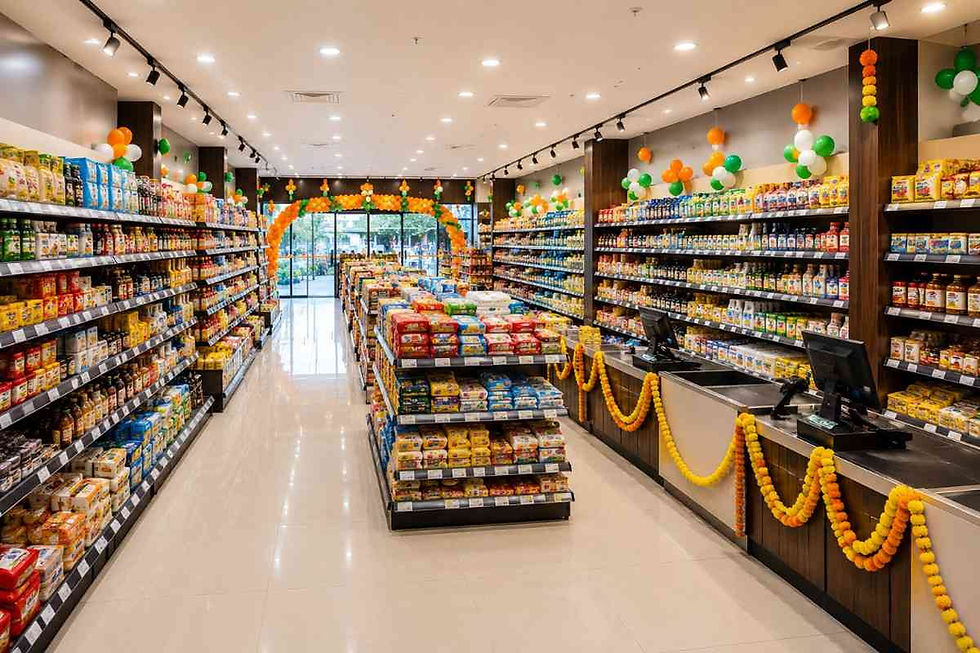
The reason is simple: families in Tier 3 Telangana towns want to shop in clean, modern stores, and as organized retail expands into these markets, the franchise opportunity will be significant. This gap between high demand and low supply is the perfect opening for a grocery franchise.
Key Highlights
Growth in Indian retail has clearly tilted toward smaller towns, and Telangana's Tier-3 markets sit right in that path.
Organised grocery is crossing a tipping point; its share of food and grocery sales is climbing fast while still leaving most of the market open.
These towns offer lower running costs and lighter competition than cities, which suits a grocery franchise well.
Rising incomes and everyday digital habits mean small-town shoppers now want a modern store, not just the nearest one.
Towns like Warangal, Karimnagar, Nizamabad, and Khammam are early names to watch.
The window is open but not unlimited; the advantage goes to whoever establishes trust first.
The short answer: why Tier 3 Telangana is poised to break out
The "Smart Pantry" Analogy: Imagine your kitchen pantry could talk to the local wholesaler. Every time you used the last bag of rice, the pantry automatically told the wholesaler to send another bag before you even realised it was empty. That is exactly what SuperK's Supermarkets' inventory technology does for your store: it ensures you never run out of what customers want.
The market signals pointing to 2026
We don't have to guess about the future because the data is already showing us the way.
Signal | Current Trend | Why this helps your store |
Market Share | Organized retail is hitting 18-22% of all grocery sales in 2026. | More people are leaving old, cramped shops for modern supermarkets. |
Growth Speed | Modern stores are growing by 14-16% every year. | You are entering a market that is expanding, not shrinking. |
Digital Habits | Tier 2 and 3 towns now drive 60% of online FMCG activity. | Customers are already comfortable using apps for loyalty and rewards. |
Competition | Very few modern chains exist in Tier 3 towns. | You can become the "go-to" store before the big city giants arrive. |
Organised retail is crossing a tipping point
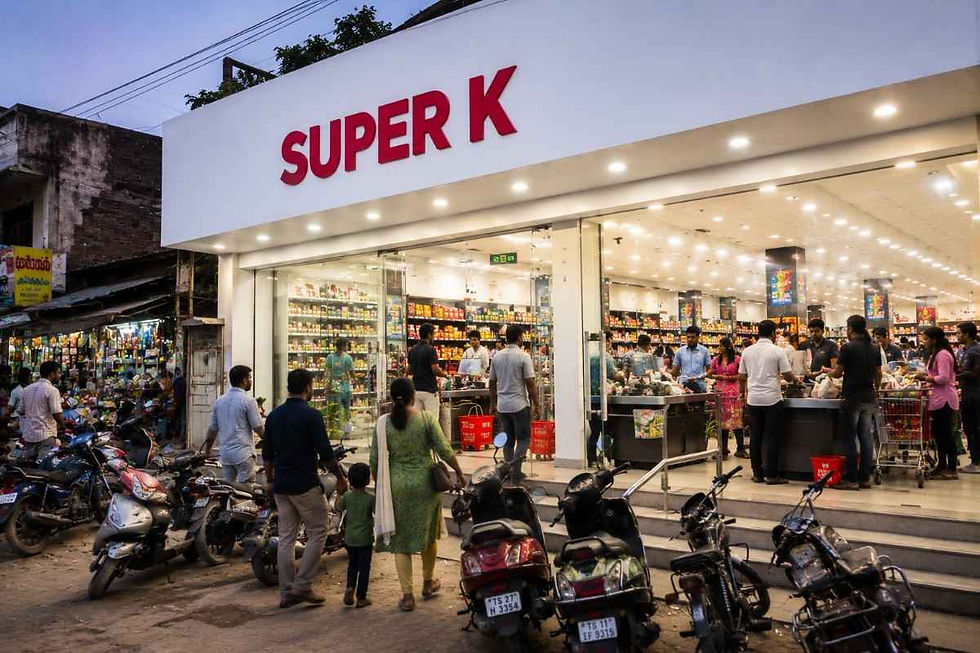
The way people buy food is changing forever. While traditional "kirana" shops still serve many people, the shift toward organized, branded stores is accelerating at 14-16% per year. In plain terms, the "modern" share of the market is currently small enough that there is plenty of room to grow, but it is moving fast enough that the best time to start is now.
Demand has shifted to smaller towns
The big city markets are crowded, but there is a "Bharat surge" happening in smaller towns. Leaders in the retail industry are seeing a massive shift in demand toward Tier 2 and Tier 3 cities. In fact, nearly 60% of digital transactions for daily essentials now come from these regions.
Why Tier 3 towns suit a grocery franchise specifically

Grocery is a "sticky" business; people need to eat no matter what the economy is doing. A franchise gives you the tools of a big corporation while you keep the heart of a local business owner.
Tech Made Simple: Store Operations
Smart Billing: You use a Point-of-Sale (POS) system that records every sale instantly.
Data Flow: This sale info goes to the "Retail Operating System," which acts like a digital brain for your business.
Automatic Reordering: The system looks at what sold and automatically suggests what you should order next.
No Dead Stock: Because the computer helps you order, you don't waste money on products that just sit on the shelf.
Cause and Effect: Business Outcomes
Action (Cause) | Result (Effect) |
Use automated stock replenishment. | You have more cash on hand because you aren't overbuying stock. |
Offer 10% Gold Member cashback. | Customers come back more often, creating steady monthly revenue. |
Centralized procurement. | You get lower prices from brands that only big chains usually get. |
Which Telangana towns to watch
The best opportunities are in district towns where people have rising incomes but limited modern shopping options.
The Big Three: Warangal, Karimnagar, and Nizamabad.
Rising Stars: Khammam, Mahbubnagar, Siddipet, and Nalgonda.
When looking at a town, check if there is a population of 20,000 to 5 lakhs and good road connectivity. If there are no modern chains there yet, that is your "green light."
What this means for you as an investor
In 2026, the real value isn't just in the items you sell but in the 500 loyal households you sign up for your membership program. These members drive the majority of your monthly sales, with every 100 members adding approximately ₹2-2.5 lakh in monthly revenue.
The "Membership Magnet" Analogy: Think of a membership program like a "digital handshake." You give the customer a reason to come back (cashback), and in return, they give you a steady, predictable income every month. Best of all, with SuperK Supermarket, the 10% cashback is paid for by the company, not out of your profit.
Conclusion:
Tier 3 Telangana towns are entering a major retail growth phase. With rising demand, lower competition, and modern franchise support already proven in Andhra Pradesh, this will be a strong market when expansion begins.
Frequently Asked Questions
1. Why are Tier 3 towns in Telangana good for grocery franchises?
Lower competition, rising incomes, and growing demand for modern stores make these towns highly profitable for grocery businesses.
2. Which Telangana towns are best for supermarket franchises?
Warangal, Karimnagar, Nizamabad, Khammam, and Siddipet are emerging as strong retail growth markets.
3. How much investment is needed for a grocery franchise?
Most small-format grocery franchises in Telangana need around ₹10-13 lakhs, including setup and inventory.
4. Is grocery retail profitable in Tier 3 towns?
Yes. A well-managed store can generate ₹30,000 to ₹1.5 lakh monthly profit after stabilization.
5. Why is organized retail growing in small towns?
Consumers now prefer clean stores, digital billing, cashback offers, and better shopping experiences.
6. Do I need retail experience to start a franchise?
No. Most grocery franchise brands provide training, inventory support, and operational guidance.
7. How does technology help grocery franchises?
POS systems and automated inventory tools reduce wastage and improve stock management efficiency.
8. Is quick commerce a threat in Tier 3 towns?
Not significantly. Most smaller towns still rely heavily on trusted local supermarkets for essentials.
9. What store size is ideal for a grocery franchise?
A 500-1,200 sq ft store in a high-footfall residential area works best for Tier 3 towns.
10. How long does it take to recover the investment?
Most grocery franchise stores recover investment within one to three years, depending on location and sales.
“SuperK is currently focused on Andhra Pradesh and plans gradual expansion into Telangana. If you are based in Telangana and want to be among the first franchise partners when expansion begins, contact the SuperK team today."


Comments